Title: Reconomy Project
MAIN PHASE
Project number: SOE-11
Title: “Digitalization of sectors with growth potential for better economic opportunities”
Donor: The Swedish International Development Cooperation Agency (Sida)
Duration: 01.07.2023 to 31.12.2026
Budget: Euro 1.980.258,55
Area: Western Balkan countries: Albania, Bosnia and Hercegovina, Kosovo, Montenegro, North Macedonia, Serbia
Project Coordinator: Gent Saraçi
General Objective: to achieve sustainable, large-scale and socially inclusive impact through systemic change and acting in a facilitative role towards stakeholders and beneficiaries.
Specific Objective:
- Women and youth, including the most disadvantaged and excluded, benefit from improved economic opportunities (better income and green and decent jobs) inclusively and sustainably
- to contribute to an increased level of regional cooperation among the WB countries
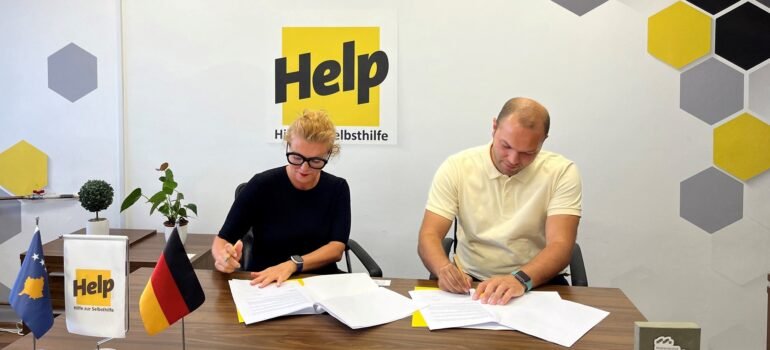
Description: Help has been working in Western Balkan to enhance living conditions and support social inclusion of marginalized population groups. As part of the cooperation with HELVETAS Swiss Intercooperation (‘Helvetas in the following’) the Regional Programme Digitalization of sectors with growth potential for better economic opportunities” in Western Balkans which is funded Swedish International Development Cooperation Agency (Sida) was launched.
Helvetas and Help are committed to leveraging their organisational capacities and resources to the best possible manner and supporting each other in fulfilling the stated objectives and obligations towards Sida. They are guided by the shared ambition to achieve sustainable, large-scale and socially inclusive impact through systemic change and acting in a facilitative role towards stakeholders and beneficiaries. The partnership adheres to principles of good governance (transparency, accountability, participation, non-discrimination, efficiency) and builds on mutual trust and respect.
The vision statement of the joint activity is for sector representatives to benefit from economic opportunities and contribute to local economic development by advancing knowledge and skills, increasing market access, sales and income.
The lack of cooperation between ICT companies and other industries is hindering the development of new products and services in the Western Balkans. This problem is compounded by technological underdevelopment, low investment in key sectors such as agriculture, tourism, and manufacturing, and limited digitalization skills among the workforce.
Climate-dependent industries, such as agriculture and tourism, face significant challenges due to climate change, unsustainable natural resource management, and energy issues. Households engaged in these industries are particularly vulnerable to such events. Failure to meet environmental standards in the supply chain and adapt to growing consumer demand for sustainability may lead to lower household income and further impoverishment of small family businesses.
To address these challenges, it is important to promote greater cooperation between the ICT industry and other sectors, as well as to invest in technological development and digitalization skills. Furthermore, efforts should be made to build resilience in climate-dependent industries through the adoption of climate-resilient practices and resource-efficient production methods.
Number of women and youth with additional income and decent and green job opportunities: 11.000, women 50%, moat disadvantaged 10%, green jobs 30%
Main activities:
- Implementation of Market System Analysis
- Identification of potential cooperating partners (Market Actors)
- Identification of appropriate interventions
- Monitoring of interventions implemented by selected Market actors
- Reporting to Helvetas
Project number: SOE-12
Project title: “Inclusive jobs in ICT”
Donor: The Swedish International Development Cooperation Agency (Sida)
Cooperation Partner to Sida: Helvetas Swiss Intercooperation
Implementing Partner to Helvetas: Help – Hilfe zur Selbsthilfe e. V
Project Team Leader: Gent Saraçi
Project duration: April 2023 – December 2026
Project budget: CHF 600.141,85
Project area: Moldova, Georgia, Armenia and Ukraine
The overall objective: The overarching objective of the program is to enable women and young men, including the most disadvantaged and excluded groups, to benefit from economic opportunities by increasing their income and taking up decent/green employment/self-employment.
The project summary:
The project has three main pillars: skills and intermediation service development, business services development, and advocacy. Its goal is to facilitate the development of demand-driven products and services that will increase the target group’s participation in the labor market and enable them to take advantage of decent job opportunities. The project is focused on stimulating systemic changes in the ICT-BPO sector. This involves working with various stakeholders, including private sector companies, industry associations and government agencies, to identify and address key challenges and opportunities in the sector.
Impact indicators:
- Number of women and youth with additional income and decent and green job opportunities (target: 6000, out of which 50% women, 10% green jobs, 20% the most disadvantaged)
- Percentage of women and youth with additional income and decent job opportunities who express satisfaction with their situation (target: 75%)
Outcome indicators:
- Amount of additional investment made by private sector enterprises because of changes stimulated by the program (target: CHF 1.000.000)
- Percentage of private sector enterprises that report higher turnover and/or profit as a
result of changes stimulated by the program (target: 20%)
- Number of women and youth with improved skills relevant to market needs (target: 2.025, out of which out of which 50% women, 10% green, 20% the most disadvantaged)
- Percentage of women and youth who express satisfaction with the relevance of skills (target: 75%)
- Number of women and youth that access and use intermediation services (target: 1.460, out of which 50% women, 20% the most disadvantaged)
- Number of private sector enterprises report better performance as a result of clear and implemented policies/regulations/administrative requirements as a result of the program’s facilitation (target: 100)
- Percentage of private sector enterprises that report increased economic opportunities and business environment (40%)
INCEPTION PHASE – SOE06

ECONOMIC SECTOR / MARKET – Information communication and technology (ICT), Business Process Outsourcing (BPO) SUPPORTING FUNCTION/RULE – Skills development, financial and business services, coordination
TIME FRAME & PLACE – August 2020 – April 2022 Western Balkans
CO-FACILITATION PARTNER – Help – Hilfe zur Selbsthilfe e.V
Focus
This pilot idea focuses on regionally replicating and improving successful models from Albania and Bosnia & Herzegovina in the ICT and BPO sectors in Serbia, North Macedonia, Kosovo & Montenegro. The pilot idea also builds on (a) the proposal submitted by Help which the Sida program selection committee evaluated and (b) complementary assessments of ideas generated by the Sida program in June and July as part of designing the program.
Vision
The ICT-BPO pilot effectively responds to the critical constraints and create a Western Balkan ‘value proposition’. This in practice means branding of the region by stimulating the competitiveness of private sector enterprises and creating a critical mass by attracting more services and clients. This is expected to generate more inclusive and sustainable benefits for women and young people as well as other disadvantaged and excluded groups.
The pilot facilitates:
1. Access to better functioning business services (e.g. information /research and knowledge generation),
2. The supply of skilled workforce (with better employability or freelancing) demanded by the private sector and facilitation of participation on the freelance brokering platforms, and the improvement of the membership organizations’ business development to link domestic companies and foreign clients as well as an advocate towards a regional brand for the promotion of the BPO sector.
- During the inception phase covering the period from 01.09.2020 to 30.04.2022, Help implemented the project related activities with a focus on understanding the main intervention logic of the programme and the contextual challenges of the Information Communication Technology (ICT) sector in the Western Balkans (WB).
- In June 2021 first amendment was signed covering an increase in the project budget.
- In May 2022 a second amendment was signed extending among other the duration of the agreement until 31.03.2023.
- During the pilot and inception phase in Reconomy, Help worked with several partners in the WB region such as: Semos Education (Serbia), The Serbian Games Association (SGA), ICT Cortex (Montenegro), Melita & Partners (Kosovo and Albania), INDUSTRIA FILM (Kosovo), SDA Academy (Albania), Bit Alliance (Bosnia & Herzegovina), Logate (Montenegro), BONEVET (Kosovo),
- The pilot effectively responded to the critical constraints and created the Western Balkan ‘value proposition’. This in practice means branding of the region by stimulating the competitiveness of private sector enterprises and creating a critical mass by attracting more services and clients. This generated more inclusive and sustainable benefits for women and young people as well as other disadvantaged and excluded groups.
- Access to better functioning business services (e.g. information /research and knowledge generation),
- The supply of skilled workforce (with better employability or freelancing) demanded by the private sector and facilitation of participation on the freelance brokering platforms, and the improvement of the membership organizations’ business development to link domestic companies and foreign clients as well as an advocate towards a regional brand for the promotion of the BPO sector.